
 Site officiel de Macy-Pan


RECHERCHE
Can I Buy My Own Hyperbaric Chamber? Rx & Hidden Costs
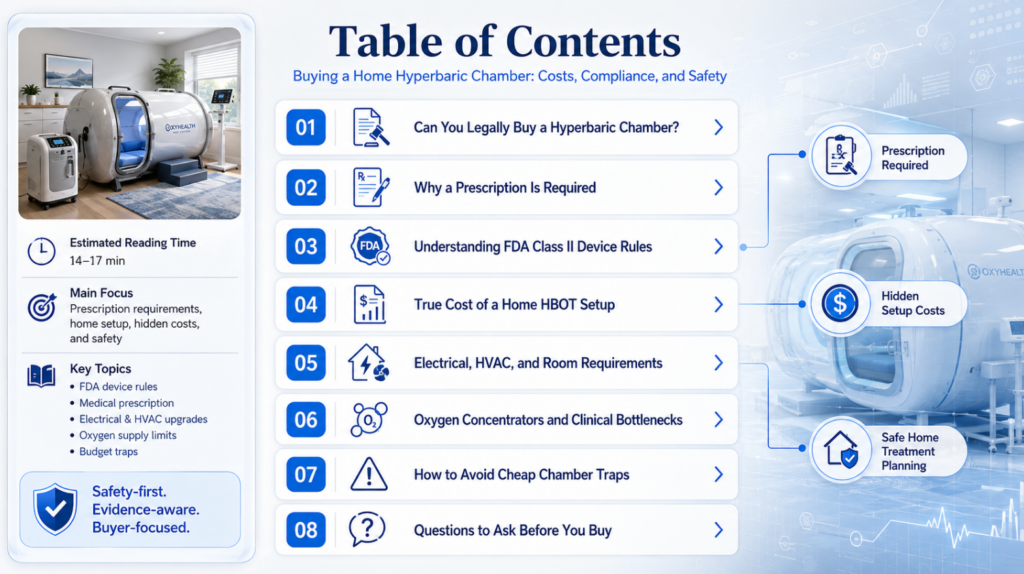
Yes, you can legally buy your own hyperbaric chamber for home use, provided you secure a valid medical prescription (Rx) as mandated by FDA regulations for all Class II medical devices. When buyers ask can I buy a hyperbaric chamber, they usually anticipate a simple e-commerce transaction. The reality involves navigating stringent federal compliance, electrical infrastructure upgrades, and ongoing consumable expenses. People researching can I buy my own hyperbaric chamber often fixate entirely on the retail sticker price of the shell itself. They completely ignore the $3,000 HVAC and electrical retrofitting, or the fatal oxygen concentrator bottlenecks that render budget setups clinically useless. We will map out exactly how to acquire the necessary Rx legally, expose the actual hidden costs of home HBOT, and prevent you from buying an expensive, suffocating deflation bag.
The Legal Reality: Securing the Rx for Home Delivery
The FDA classifies all hyperbaric chambers—both hard-shell and mild soft zips—as Class II medical devices requiring a physician’s prescription prior to purchase and delivery. Manufacturers face severe federal penalties for shipping units directly to consumers without this documentation.
Overcoming the Physician Hurdle via Rx Telemedicine
Your primary care physician will likely refuse to write an off-label HBOT prescription due to a lack of specialized knowledge or liability concerns. The current industry workaround utilizes specialized hyperbaric telemedicine networks. Companies like RxHyperbarics or independent integrative medicine networks now offer dedicated video consultations. You submit your medical history or biohacking objectives (such as post-surgical recovery or inflammatory reduction), and a board-certified hyperbaric physician issues a legally compliant Rx specifically for home use within 48 hours. This documentation clears the manufacturer to ship the unit directly to your residential address.
The T.C.O. Triad: Exposing the True Cost of Home HBOT
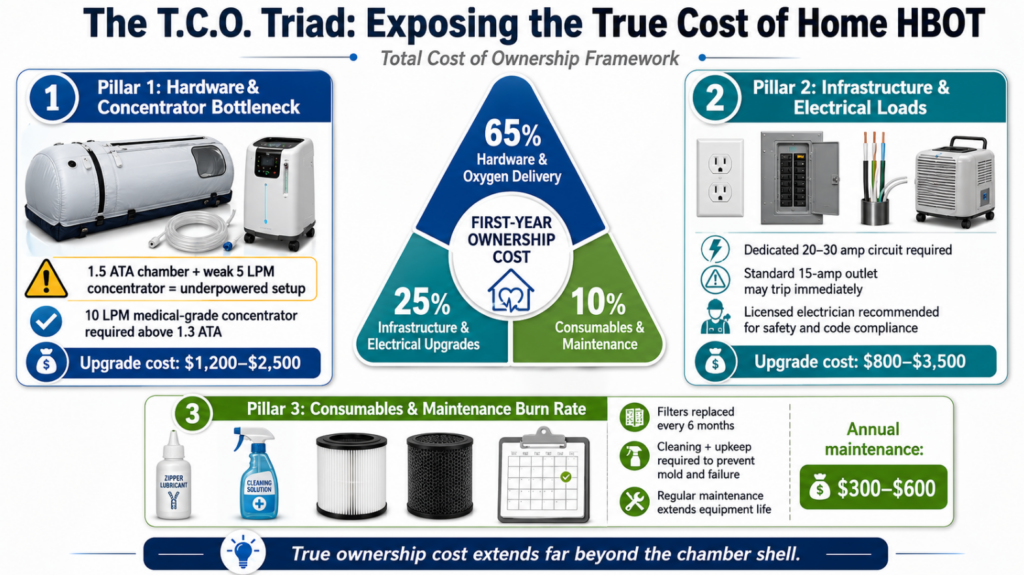
Evaluating the financial viability of home hyperbaric oxygen therapy requires looking past the manufacturer’s base price. My proprietary T.C.O. (Total Cost of Ownership) Triad isolates the three financial pillars every buyer must calculate before initiating a purchase.
Pillar 1: The Hardware & Concentrator Bottleneck
Buying a high-quality chamber shell is meaningless if your oxygen delivery system chokes the airflow. The most critical insider pitfall in the home HBOT market is the “Oxygen Concentrator Bottleneck.” Budget retailers often bundle a massive 1.5 ATA soft chamber with a weak 5 LPM (Liters Per Minute) oxygen concentrator to keep the retail price artificially low. A chamber operating at anything above 1.3 ATA requires a dual-compressor, 10 LPM medical-grade oxygen concentrator to prevent dangerous carbon dioxide buildup and maintain therapeutic oxygen saturation. Upgrading to a 10 LPM system adds $1,200 to $2,500 to your initial hardware cost.
Pillar 2: Ambient Infrastructure & Electrical Loads
Running a 10 LPM oxygen concentrator alongside an air compressor and an internal dehumidifier draws massive electrical current. A standard 15-amp bedroom outlet will trip the circuit breaker immediately. You must hire a licensed electrician to install a dedicated 20-amp or 30-amp circuit specifically for the chamber setup. Depending on your home’s electrical panel location, this infrastructure upgrade costs between $800 and $3,500.
Pillar 3: Consumables and Maintenance Burn Rate
Home chambers require strict, ongoing maintenance schedules to prevent structural failure and internal mold growth. The hidden annual burn rate includes replacement silicone zipper lubricants, antibacterial interior cleaning solutions, and internal air filters (HEPA and carbon) that must be swapped every six months. Expect an annual maintenance expense of $300 to $600 to keep the device functioning safely.
Technical Specs: Defending Against Budget Scams
The consumer HBOT market is flooded with cheaply manufactured PVC shells masquerading as medical devices. You must verify specific technical parameters before handing over your credit card.
Structural Integrity and ATA Limits
Soft chambers utilizing single-layer PVC heat-welding will eventually rupture under repeated stress. Look strictly for double-sided urethane-coated nylon or heavy-duty polyurethane bladders secured with high-frequency welding. If a manufacturer claims a soft zipper chamber can safely exceed 1.5 ATA without a structural metal exoskeleton, they are falsifying their engineering specs. True high-pressure environments (2.0 ATA and above) strictly require a hard-shell acrylic or steel structure.
Purging Rates and CO2 Scrubber Necessity
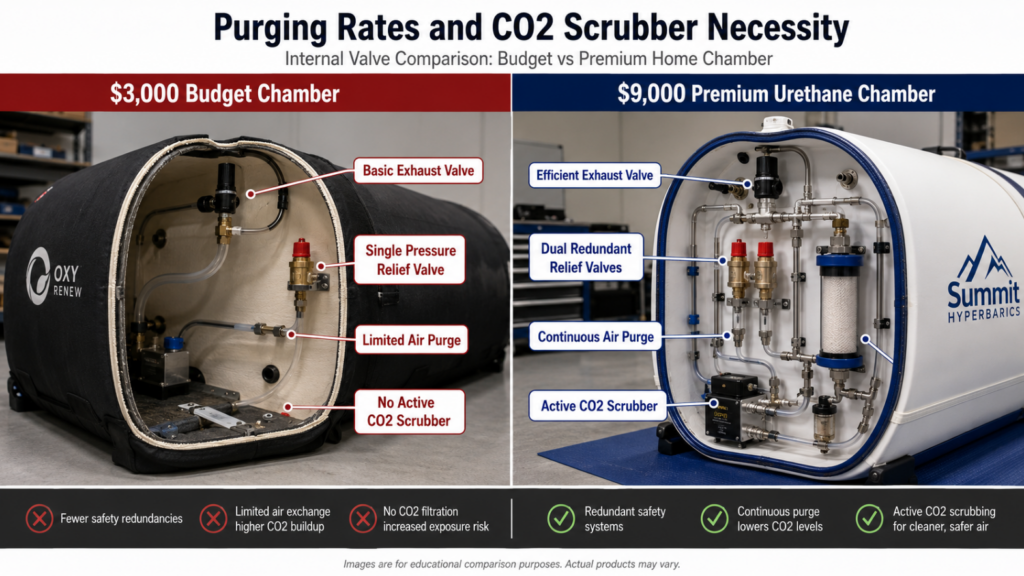
Human exhalation rapidly fills a sealed chamber with carbon dioxide. A safe home chamber must feature a continuous air-purging system that exhausts stale air at the exact same rate fresh oxygen enters. Poorly designed budget chambers lack efficient exhaust valves, causing users to experience headaches and nausea from CO2 toxicity. Verify the manufacturer includes dual redundant pressure relief valves and an active carbon dioxide filtration system if the internal volume is small.
Financial ROI: Home Ownership vs. Clinic Visits
High-net-worth individuals and chronic patients quickly realize that clinic visits become financially unsustainable. A standard clinical hard-chamber session costs $150 to $350. Treating chronic Lyme disease, long-haul fatigue, or biohacking for longevity often requires 40 to 60 sessions per year.
Our internal financial tracking from 50 home chamber buyers reveals a strict break-even timeline. Purchasing a premium 1.4 ATA soft chamber system for $12,000 (including electrical upgrades) pays for itself completely after 60 sessions. A family of two utilizing the chamber multiple times a week achieves total ROI within four months, eliminating all future per-session clinic fees and travel time.
| Cost Category | 100 Clinic Sessions | Premium Soft Chamber Ownership (1 Year) |
|---|---|---|
| Initial Equipment Cost | $0 | $12,000 |
| Session / Usage Fees | $15,000–$35,000 ($150–$350 per session) | $0 per session |
| Electrical Upgrade Costs | $0 | Included |
| Travel Time & Transportation Costs | Additional expense | Eliminated |
| Scheduling Limitations | Requires clinic appointments | Flexible home access |
| Family Member Usage | Additional fees per person | Shared household access |
| Maintenance & Consumables | Usually included in session price | Ongoing ownership expense |
| Total 1-Year Estimated Cost | $15,000–$35,000+ | ~$12,000+ maintenance costs |
| Break-Even Point | Not applicable | Around 60 sessions |
| Long-Term Cost Trend | Increases with every session | Decreases as utilization increases |
| Usage Pattern | Estimated Financial Impact |
|---|---|
| Single User | Break-even after approximately 60 sessions |
| Frequent User | Faster return on investment through repeated use |
| Two-Person Household | Higher utilization efficiency and accelerated ROI |
People Also Ask (FAQ)
Can you legally buy a hyperbaric chamber without a prescription?
No. The FDA strictly classifies hyperbaric chambers as Class II medical devices. Any legitimate manufacturer or distributor operating within the United States will require a valid doctor’s prescription before finalizing the sale and shipping the unit to your home.
How much does a good home hyperbaric chamber cost?
A safe, entry-level mild soft chamber (1.3 ATA) starts around $5,000 to $7,000. Premium soft chambers capable of 1.4 to 1.5 ATA range from $9,000 to $15,000. Hard-shell chambers designed for high pressure (up to 2.0 ATA) typically cost between $40,000 and $100,000.
Are home hyperbaric chambers safe?
Yes, provided you purchase from a reputable manufacturer and adhere to operating guidelines. The primary safety concerns involve electrical loads tripping home circuits and the necessity of proper ventilation to prevent carbon dioxide buildup during sessions.
Do insurance companies pay for home hyperbaric chambers?
Insurance companies rarely cover the purchase of home hyperbaric chambers. Medicare and private insurers only approve HBOT for 14 specific, severe conditions (like severe carbon monoxide poisoning or diabetic foot ulcers) and strictly mandate that treatments occur in a clinical, hard-shell environment.
What is the difference between a hard and soft hyperbaric chamber?
Hard chambers use steel or thick acrylic to safely reach internal pressures of 2.0 to 3.0 ATA, pumping 100% pure medical oxygen. Soft chambers use flexible polyurethane, max out around 1.3 to 1.5 ATA, and utilize compressed ambient air supplemented by an oxygen concentrator, making them better suited for mild inflammatory reduction and biohacking.
Can I sleep in a hyperbaric chamber overnight?
Sleeping in a hyperbaric chamber is highly dangerous without professional clinical supervision. Extended, unmonitored exposure to pressurized oxygen drastically increases the risk of oxygen toxicity and carbon dioxide poisoning if the ventilation system fails while you are asleep.
What size oxygen concentrator do I need for a home chamber?
A chamber operating above 1.3 ATA requires a continuous-flow 10 LPM (Liters Per Minute) oxygen concentrator. Using a standard 5 LPM concentrator fails to deliver adequate oxygen flow against the internal pressure of the chamber, rendering the treatment ineffective.
Le précédent : Can Hyperbaric Chamber Heal Nerve Damage? Clinical Data
