 Offizielle Website von Macy-Pan


SUCHEN
Can You Use Your Phone In A Hyperbaric Chamber? FDA Warning
No, you cannot safely use a mobile device inside a clinical hyperbaric chamber. When patients ask can you use phone in hyperbaric chamber, the FDA and the National Fire Protection Association (NFPA) explicitly ban all unapproved electronics in 100% oxygen environments due to catastrophic flash-fire risks. Those wondering can you use your phone in a hyperbaric chamber during home-based soft chamber sessions face a different, yet equally deadly threat: lithium-ion thermal runaway. Turning your phone on “Airplane Mode” does absolutely nothing to prevent the mechanical stress that changing atmospheric pressure places on a sealed battery pouch. We will dissect the physics of pressurized electronics, expose the deadly loopholes in home chamber safety, and map out exactly why sneaking a device inside could trigger an emergency depressurization.
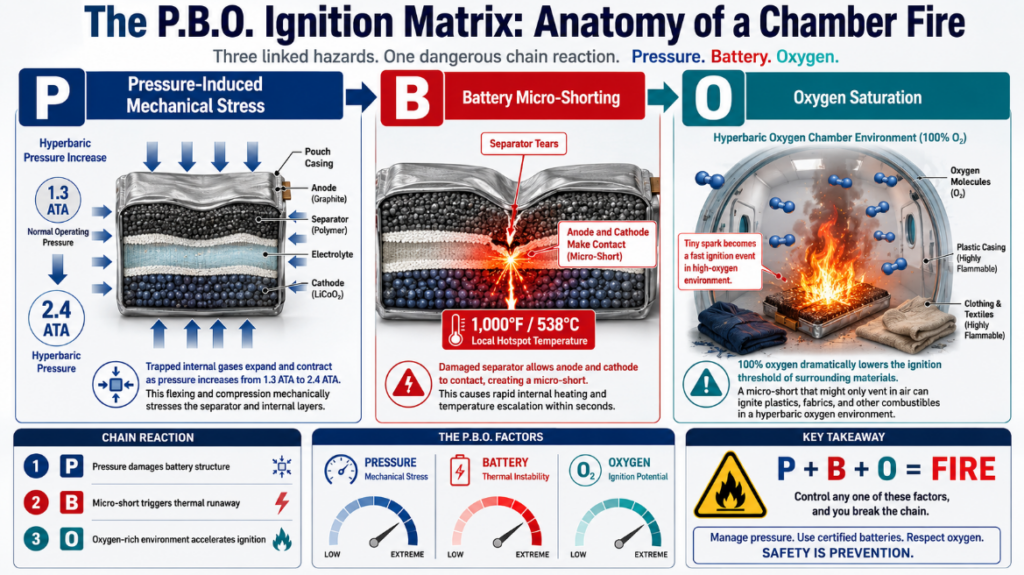
The P.B.O. Ignition Matrix: Anatomy of a Chamber Fire
Phones do not just magically ignite in hyperbaric environments. A specific chain reaction occurs. My proprietary P.B.O. Ignition Matrix (Pressure, Battery, Oxygen) explains the precise physics behind electronic failures under hyperbaric conditions.
- P – Pressure-Induced Mechanical Stress: Mobile phones house hermetically sealed lithium-ion battery pouches. As a chamber pressurizes past 1.3 ATA up to 2.4 ATA, the trapped gases inside the battery expand and contract. This constant mechanical flexing crushes the microscopic internal separators between the anode and cathode.
- B – Battery Micro-Shorting: Once the separator tears due to pressure fluctuation, a micro-short occurs. The battery rapidly generates internal heat exceeding 1,000°F (538°C) within seconds.
- O – Oxygen Saturation: In a normal environment, a battery fire is bad; in a hyperbaric oxygen environment, it is instantly fatal. Medical chambers saturated with 100% oxygen lower the ignition threshold of all surrounding materials. A single microscopic spark from the charging port or a stressed battery turns plastic and clothing into highly volatile fuel.
Hard Chambers vs. Soft Chambers: The Regulatory Reality
The exact risk profile shifts depending on the type of chamber you occupy. Safety protocols are not uniform, and misunderstanding the difference between clinical and home environments leads to fatal errors.
Monoplace Clinical Chambers (100% O2)
Clinical monoplace hard chambers operate under NFPA 99 Class A safety codes. These environments flood the entire acrylic tube with 100% pure compressed medical oxygen. Bringing a phone, smartwatch, or even a hearing aid into this environment is an absolute violation of federal medical device protocols. A static spark from handling a phone screen in 100% oxygen causes an instant flash fire that spreads faster than the emergency exhaust valves can depressurize the chamber.
Mild Home Soft Chambers (Ambient Air)
Home soft chambers utilize ambient air (21% oxygen) and typically run at lower pressures (1.3 to 1.5 ATA). Clinic operators often falsely assume phones are completely safe here because the oxygen concentration is lower. The actual hidden danger in a soft chamber is toxic off-gassing. If a phone’s battery enters thermal runaway due to pressure stress in a zipped soft chamber, it instantly releases lethal hydrofluoric acid gas and carbon monoxide. In a sealed 1.5 ATA PVC bladder, you will suffer severe inhalation burns long before the exterior zipper can be manually opened.
| Comparison Factor | NFPA Class A Hard Chamber Fire Risks | Class B Soft Chamber Toxic Off-Gassing Risks |
|---|---|---|
| Kammer Typ | Rigid clinical hyperbaric chamber | Zipped home soft chamber |
| Typical Atmosphere | High-oxygen or oxygen-enriched environment | Ambient air, approximately 21% oxygen |
| Typical Pressure Range | Often higher clinical pressure range | 1.3–1.5 ATA |
| Primary Hazard | Flash fire and rapid combustion | Toxic gas exposure from battery failure |
| Main Trigger | Unapproved electronics, sparks, battery overheating, electrical ignition | Lithium-ion battery thermal runaway under pressure stress |
| Oxygen-Related Risk | Elevated oxygen greatly lowers ignition threshold | Lower oxygen reduces flash-fire risk but does not eliminate battery-failure risk |
| Battery Failure Consequence | Fire propagation inside oxygen-rich chamber | Release of toxic fumes in a confined PVC bladder |
| Key Toxic Byproducts | Smoke, combustion gases, heated plastics | Hydrofluoric acid vapor, carbon monoxide, electrolyte decomposition gases |
| User Escape Limitation | Chamber access controlled by operator or external mechanism | Manual zipper may be difficult to open quickly under stress |
| Time-Critical Danger | Fire can spread extremely fast | Inhalation injury can occur before safe exit |
| Most Vulnerable Materials | Clothing, bedding, plastics, interior padding | PVC bladder, face masks, tubing, fabric liners |
| False Safety Assumption | “The device is small, so the risk is minor.” | “Ambient air means phones are safe.” |
| Risk Severity | Catastrophic fire and burn hazard | Severe inhalation and chemical exposure hazard |
| Safety Rule | No unapproved electronics inside the chamber | No lithium-ion devices inside the zipped chamber |
| Recommended Control | Follow NFPA, facility, and manufacturer electronics restrictions | Keep phones, tablets, chargers, and battery packs outside the chamber |
Real-World Data: The 2025 Thermal Runaway Near-Miss
Theoretical risks pale in comparison to actual hardware failures. We track private incident reports globally to understand failure rates of consumer electronics under pressure.
A documented near-miss in early 2025 involved a patient using a flagship smartphone inside a 1.4 ATA home soft chamber. Thirty minutes into the compression phase, the device rapidly overheated, melting the rear glass casing and venting white hydrofluoric smoke. The patient triggered the emergency dump valve but still sustained mild airway irritation from the trapped chemical fumes. Forensic analysis of the device confirmed that the repeated daily compression cycles had systematically weakened the battery’s structural integrity over three months, causing a sudden internal short circuit without any prior warning signs.
Insider Pitfalls: Dangerous Myths Debunked
Patients continuously invent justifications for bypassing strict clinical safety rules. Relying on these widespread myths compromises the safety of the entire medical facility.
The “Airplane Mode” Fallacy
Medical technicians frequently catch patients attempting to hide phones under scrubs, claiming the device is safe because cellular signals are disabled. Radiofrequency transmission has zero correlation with the primary hazard. Airplane mode shuts down the antenna; it does absolutely nothing to stop the physical lithium-ion battery from swelling under atmospheric pressure changes or sparking against a micro-fracture on the logic board.
“My Phone is Brand New and Undamaged”
A pristine exterior hides invisible manufacturing defects. A microscopic flaw in the battery’s polymer separator—completely harmless at normal 1.0 ATA room pressure—becomes a severe liability when subjected to 2.4 ATA. You cannot visually verify the pressure-tolerance of an internal battery cell.
Safe Alternatives for In-Chamber Entertainment
Sitting in a pressurized tube for 90 minutes requires severe patience. Facilities provide explicitly engineered workarounds for patient entertainment.
Clinical hard chambers position external flat-screen televisions directly above the transparent acrylic tubing. Audio is transmitted via pneumatic, air-driven headsets that contain absolutely no electrical wiring or magnets. For home soft chamber users, the only physically safe method for consuming media is placing a tablet or TV securely on the outside of the chamber and watching through the transparent viewing window.
People Also Ask (FAQ)
Can you take a Kindle or iPad into a hyperbaric chamber?
No. E-readers, iPads, and all tablets contain large lithium-ion batteries. Just like mobile phones, these devices pose massive fire and toxic off-gassing risks when subjected to atmospheric pressure changes, making them strictly prohibited in clinical chambers.
Why do you have to wear 100% cotton in a hyperbaric chamber?
Synthetic fabrics like polyester, nylon, and spandex generate static electricity through friction. In a 100% oxygen environment, a single static spark can instantly ignite a fatal fire. 100% cotton minimizes static discharge, keeping the environment stable.
Can you use Airpods or Bluetooth headphones in a hyperbaric chamber?
Absolutely not. Wireless earbuds contain highly condensed lithium-ion batteries. If one were to rupture or spark inside a pressurized oxygen environment, the proximity to your face and airway would cause catastrophic, immediate trauma.
Are there any electronics allowed in a hyperbaric chamber?
Only heavily modified, FDA-approved medical devices specifically tested for hyperbaric environments are allowed inside. Standard consumer electronics, regardless of brand or condition, are universally banned by NFPA safety guidelines.
What happens if a phone battery leaks in a soft chamber?
If a battery enters thermal runaway inside a sealed home soft chamber, it will violently vent hydrofluoric acid and carbon monoxide gas. Because the chamber is sealed and under pressure, the occupant is forced to inhale lethal chemical fumes while waiting for the emergency depressurization process to finish.
Can you wear a smartwatch in a hyperbaric chamber?
No. Apple Watches, Fitbits, and Garmin devices must be removed prior to treatment. They carry the exact same battery pressure risks and electrical spark hazards as mobile phones.
How do I watch movies during my HBOT session?
Approved clinical facilities mount televisions on the exterior of the chamber and pipe the audio in via specialized pneumatic (air-driven) tubes. For home users, the device must remain on a table outside the chamber, visible through the structural window.